
NEWS
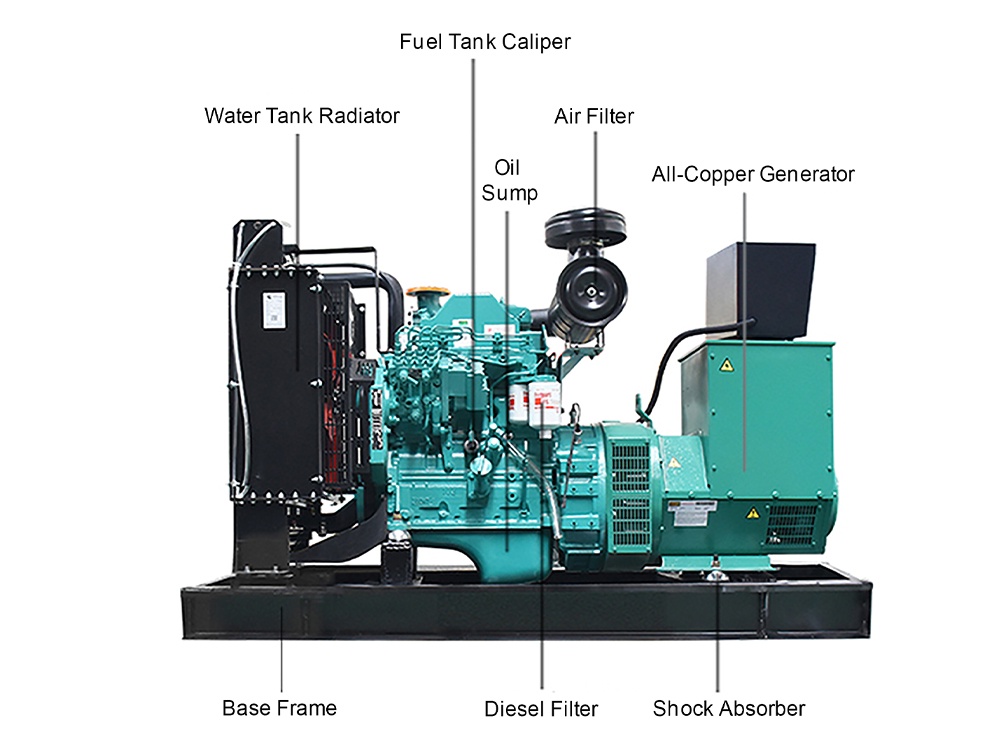
Engine System Components: An engine primarily consists of a fuel supply and governing system, an intake and exhaust system, a lubrication system, a cooling system, and a starting and charging system.
(1) Fuel Supply and Governing System: The fuel supply system is mainly composed of components such as a fuel transfer pump, fuel filter, fuel cooler, fuel injection pump, and fuel injectors. Its function is to inject diesel fuel into the combustion chamber—at precise timing, in precise quantities, and at precise pressure—in accordance with the operating conditions required by the diesel engine. Simultaneously, through the action of the fuel injection pump and the governor, it controls the diesel engine to ensure stable operation under specified working conditions. Common fuel supply and governing systems include the plunger-type injection pump system, the PT fuel system, and electronically controlled injection systems (including high-pressure common rail systems).
(2) Intake and Exhaust System: The intake and exhaust system of a diesel engine primarily consists of an air filter, intake and exhaust manifolds, a muffler, and a turbocharging system.
(3) Lubrication System: The function of the lubrication system is to supply sufficient engine oil to the various friction surfaces within the diesel engine to minimize wear and ensure proper operation. Additionally, it serves functions such as heat dissipation, cleaning, sealing, and corrosion prevention. The lubrication system is mainly composed of components such as an oil pump, oil filter, centrifugal filter, various control valves, lubrication pipelines, and an oil cooler.
(4) Cooling System: The primary function of the cooling system is to dissipate the heat generated by combustion and friction during engine operation by means of a cooling medium, thereby ensuring that the engine operates within its optimal temperature range. Based on the type of cooling medium used, cooling systems can be classified into water-cooled and air-cooled types. Water-cooled systems are further categorized into natural circulation cooling and forced circulation cooling; forced circulation cooling systems can be further subdivided into open-loop and closed-loop types. In an open-loop forced circulation cooling system, the cooling medium is in direct contact with the atmosphere. Conversely, in a closed-loop forced circulation cooling system, the cooling medium is isolated from the external atmosphere; it circulates within a sealed system where the pressure is maintained slightly above atmospheric pressure, allowing the boiling point of the cooling medium to exceed 100 degrees Celsius. Its advantages include raising the water temperatures at both the inlet and outlet of the diesel engine—thereby minimizing the temperature differential of the cooling water—which stabilizes the engine's operating temperature and enhances its fuel efficiency. Furthermore, it raises the average temperature of the radiator, allowing for a reduction in the required heat dissipation area, a decrease in water consumption, and a shortening of the engine oil preheating time. The primary components of the cooling system include the radiator, cooling fan, water pump, cooling intensity regulator, and antifreeze coolant.
(5) Starting and Charging Systems: The entire process by which a diesel engine transitions from a stationary state to an operational state—facilitated by an external force—is referred to as the engine's starting process. The assembly of devices required to execute this starting process constitutes the starting system. Its function is to provide the necessary starting energy to drive the crankshaft rotation, bringing it up to the required starting speed (typically 150–300 rpm), thereby ensuring the reliable startup of the diesel engine.
There are generally four methods for starting a diesel generator: manual starting, electric motor starting, compressed air starting, and starting via a small auxiliary gasoline engine. Among these, electric motor starting is the most widely adopted method for the backup diesel generators utilized in data centers. The electric motor starting system primarily consists of an electric starter motor, a storage battery, and a battery charger.
NANBOWAN
Professional generator set manufacturer
24/7 before-sales and after-sales services
Comprehensive technical support